
Home › Pool tips & guides › Liner care
A well-maintained liner lasts a long time. A badly treated liner can stain, fade or weaken in a single season, and this damage is often irreversible. Here are the rules given by liner manufacturers, explained simply.
- pH between 7.2 and 7.6, free chlorine around 1 mg/L, TA (total alkalinity) between 100 and 175 mg/L.
- Zero copper in the water: metal sequestrant when filling, no copper-based products.
- Products go through the skimmer, with the filtration running. Never in direct contact with the liner.
- Waterline cleaned 2 to 3 times a week, with a sponge, nothing abrasive.
- Water at 28 °C maximum. And never empty the pool.
Why a liner needs special attention
A liner is a PVC membrane protected by a lacquer. This lacquer is tough, but it has three enemies: aggressive water (pH or TA too low, too much chlorine), dissolved metals (copper, iron, manganese) that stain it, and abrasive rubbing that wears it down. Almost every liner problem comes from one of these three things.
The right water values
Check these values regularly: chlorine and pH every day during the season, TA every week and after heavy rain, which is often acidic.
| Parameter | Recommended value for a liner |
|---|---|
| pH | 7.2 to 7.6 |
| Free chlorine (stabilised chlorine) | 0.7 to 1.2 mg/L, ideally 1 mg/L |
| Free chlorine (unstabilised chlorine: salt electrolysis, hypochlorite) | 0.3 to 0.8 mg/L |
| Bromine | 1 to 2 mg/L |
| TA (total alkalinity) | 100 to 175 mg/L |
| TH (calcium hardness) | 150 to 250 mg/L |
| Stabiliser (cyanuric acid) | 30 to 50 mg/L |
| Copper | 0.1 mg/L maximum (ideally 0) |
| Water temperature | 28 °C maximum |
Each value in detail, and what to do when it goes out of range, is explained in our guide water balance for a liner pool.
Adding treatment products correctly
- Put the products in the skimmer, whatever their form (tablets, granules, liquid), with the filter pump running.
- For a powder, a shock treatment or a flocculant: dilute the product in a watering can filled with pool water, then spread it around.
- Never let any chemical settle on the liner (a tablet on the floor, granules landing on a step…).
- No floating dispenser: it can get stuck in a corner of the pool and concentrate the product on one spot of the liner.
Danger no. 1: copper and metals
Copper, iron or manganese dissolved in the water settle on the liner and leave permanent yellow, brown or grey stains. Copper also reacts with sun creams and turns the waterline yellow.
- Add a metal sequestrant every time you fill the pool.
- Read the labels: some algaecides and some “multifunction” tablets contain copper. Choose quaternary ammonium algaecides and tablets without copper sulphate.
- Fill and top up the pool with mains water. Borehole water or water of unknown origin may contain metals: it must be treated first.
Stains already there? See our guide stains on a liner: causes and solutions.
Looking after the waterline
The waterline collects grease (sun cream, skin) and limescale. Clean it 2 to 3 times a week depending on the surroundings, with a sponge or soft cloth and a cleaner suitable for liners. No household products, no scouring pads, no wire brushes.
Step-by-step method: cleaning a liner waterline without damaging it.
Summer and winter: do not empty the pool
A liner pool must never be left empty. The water balances the pressure of the soil against the walls; without it, the structure can suffer and the liner can shrink, tear or come away. In summer, keep a constant level. In winter, choose with your pool professional between:
- active winterising: the filtration keeps running, for shorter periods;
- passive winterising: water level lowered below the skimmers and pipes drained.
Useful products for liner care
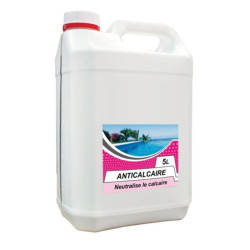
Protecting the liner from metals and limescale


Testing your water


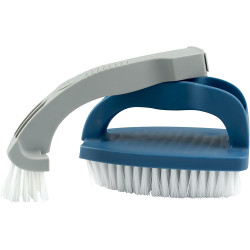
Cleaning the waterline

Frequently asked questions
How long does a pool liner last?
It mainly depends on water quality and maintenance. Balanced water (pH 7.2 to 7.6, TA 100 to 175 mg/L, no excess chlorine), free of copper and at 28 °C maximum, is the best way to make a liner last.
Can I empty a liner pool to clean it?
No. A liner pool must not be left empty: the water balances the pressure on the walls. The liner can also shrink or tear. Clean the pool while it is full, with a manual vacuum or a robot.
Can I put a chlorine tablet straight into the pool?
No. The tablet goes in the skimmer, with the filtration running. Left on the floor or in a floating dispenser that gets stuck, it concentrates chlorine on one area of the liner and bleaches it.
Why is my liner fading?
The usual causes are too much chlorine, a pH that is too low and water that is too warm. Dark colours fade faster than light ones.
Which algaecide should I use with a liner?
A copper-free algaecide, preferably based on quaternary ammonium. Copper stains the liner permanently.
How often should I clean a liner waterline?
Two to three times a week during the season, more often if the pool is used a lot or surrounded by trees.