
Home › Pool tips & guides › Water balance
Poorly balanced water is the main cause of liner damage. A TA that is too low, for example, makes the water corrosive and can cause irreversible damage. Here are the values to stick to, and how to correct them.
- Set the TA first, then the pH, then the sanitiser.
- TA: 100 to 175 mg/L. Below 100, the pH becomes unstable and the water attacks the liner.
- pH: 7.2 to 7.6. Free chlorine: around 1 mg/L with stabilised chlorine.
- Copper: 0.1 mg/L maximum.
Table of values for a liner
| Parameter | Recommended range | Check |
|---|---|---|
| TA (total alkalinity) | 100 to 175 mg/L (10 to 17.5 °f, French degrees) | Every week and after rain |
| pH | 7.2 to 7.6 | Every day during the season |
| Free chlorine – stabilised chlorine (dichlor, trichlor) | 0.7 to 1.2 mg/L, ideally 1 | Every day during the season |
| Free chlorine – unstabilised chlorine (salt electrolysis, hypochlorite) | 0.3 to 0.8 mg/L | Every day during the season |
| Bromine (heated pools) | 1 to 2 mg/L | Every day during the season |
| Stabiliser (cyanuric acid) | 30 to 50 mg/L | Every month |
| TH (calcium hardness) | 150 to 250 mg/L (15 to 25 °f) | When filling, then every month |
| Copper | ≤ 0.1 mg/L | When filling and if stains appear |
| Residual ozone (ozone pools) | < 0,01 mg/L | Depending on the unit |
| Water temperature | 28 °C maximum | — |
TA: the value to check first
TA measures the water's ability to “buffer” pH changes. If it is too low (under 100 mg/L), the pH swings up and down and the water becomes corrosive and attacks the liner. Check it every week and after rain, which is often acidic.
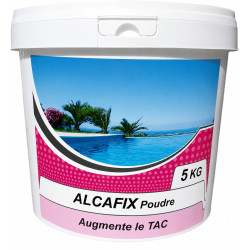
- TA too low: add an alkalinity increaser (TA+). Example given by one manufacturer: 200 g per 10 m³ raises TA by about 1 °f. Always follow the dosage on the label.
- TA too high: the pH tends to rise and limescale tends to form. Bring it down gradually with a pH reducer (pH minus), in several doses.
pH
Between 7.2 and 7.6, chlorine works well and the water is not aggressive to the liner or to swimmers. A pH that is too low makes the water corrosive and speeds up liner fading. A pH that is too high makes chlorine less effective and encourages limescale.
Chlorine: enough, but not too much
Too much chlorine bleaches the liner, especially dark colours. Combined with a low pH, it makes the water more aggressive. And the warmer the water, the faster the fading, even at the same dose.
- Stabilised chlorine (tablets, dichlor or trichlor): 0.7 to 1.2 mg/L free chlorine, measured with a DPD test.
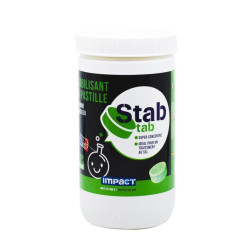
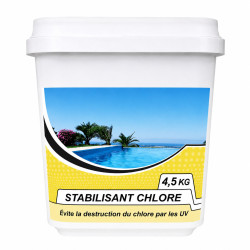
- Unstabilised chlorine (salt electrolysis, hypochlorite, liquid chlorine): 0.3 to 0.8 mg/L. Add a stabiliser to reduce how aggressive the water is: at least 20 to 30 mg/L.
- Bromine: 1 to 2 mg/L. Less volatile than chlorine, it is well suited to heated pools.
TH (limescale) and metals
Very hard water leaves a white deposit on the waterline. With a TH above 250 mg/L, use a limescale sequestrant. For metals, the rule is strict: 0.1 mg/L of copper maximum, otherwise permanent stains appear. A metal sequestrant should be added every time the pool is filled.
Products for balancing the water
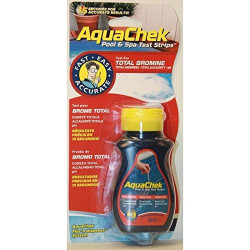
Testing


Correcting TA

Stabilising chlorine
Limescale and metals


Frequently asked questions
What is the right TA for a liner pool?
Between 100 and 175 mg/L (10 to 17.5 °f). Below 100 mg/L, the pH becomes unstable and the water becomes corrosive to the liner.
What pH for a pool with a liner?
Between 7.2 and 7.6. A pH that is too low makes the water aggressive and speeds up liner fading.
What chlorine level for a liner?
With stabilised chlorine, 0.7 to 1.2 mg/L free chlorine, ideally 1 mg/L. With salt electrolysis or unstabilised chlorine, 0.3 to 0.8 mg/L, with a stabiliser.
In what order should I correct the pool water?
First TA, then pH, then the sanitiser (chlorine or bromine). Correcting the pH before TA does not last: the pH drifts straight back.
What is the maximum temperature for a liner pool?
28 °C. Above that, the liner fades faster and becomes weaker.
Is bromine suitable for a liner?
Yes, at 1 to 2 mg/L. It is less volatile than chlorine and suited to heated pools.