
Home › Pool tips & guides › Pool pump
The pump is the heart of the filtration system: if it runs badly, so does your water. Yet most breakdowns come from a rough-and-ready installation or an overlooked maintenance detail. Here is how to read the rating plate, install the pump properly and fix the most common problems.
- The rating plate tells you everything: voltage, power, current, protection. If in doubt, the plate is what counts.
- A pump should sit on a flat, rigid base, with enough room above it to open the lid.
- Never start it dry: fill the pump housing with water before switching on.
- Low flow, noise, loss of prime: the culprit is often on the suction side (blocked basket, air leak, pipe too small).
- In winter: pump drained, drain plugs open, protected from frost.
Reading the rating plate
Every pump has a plate stuck on the motor. You need it to order the right part, check the electrical connection and compare with a replacement pump.
| Marking | What it means |
|---|---|
| Manufacturer and type | The make and exact model of the motor: essential for finding spare parts. |
| Phase (1 or 3) | Single-phase (1) or three-phase (3) motor. |
| Voltage (V) | 230 V single-phase (live + neutral + earth); 230/400 V three-phase. |
| P1 / P2 (kW) | P1 = power drawn from the mains; P2 = power delivered by the motor. Sometimes given in CV or HP (1 CV ≈ 0.736 kW). |
| Current (A) | The current drawn: used to set the motor's electrical protection. |
| RPM | Rotation speed, usually 2,800 or 1,450 rpm for pool pumps. |
| IP | The motor's protection rating against water and dust (often IP44, IP54 or IP55). |
| S/N | Serial number: quote it when ordering a part or making a warranty claim. |
Installing your pump properly
| Step | Avoid | Good practice |
|---|---|---|
| Base | Pump sitting on uneven ground: noise and vibration | Flat, rigid slab in a ventilated plant room; anti-vibration mounts if needed |
| Access | Pump pushed against a wall or under a shelf | Leave about 65 cm clear above it to open the lid and lift out the basket |
| Suction | Undersized pipe | Pipe diameter matched to the flow rate to limit pressure losses and cavitation |
| Before the pump | Elbow or manifold right at the pump inlet | A straight run of about 5 times the pipe diameter before the inlet, or a larger manifold |
| Fittings | No valves and no check valve | Isolation valves, non-return valve on the suction side, pressure gauge on the outlet side |
| Checks | Seals forgotten or badly seated | Check the O-rings and drain plugs |
| Start-up | Dry start | Fill the pump housing with water, bleed the air, then start |
| Monitoring | No readings taken at the start | Note the starting pressure and current: they act as a reference if a fault occurs |
A few useful calculations
| Rule of thumb | Example |
|---|---|
| Turnover time = pool volume ÷ pump flow rate | 80 m³ ÷ 40 m³/h = 2 h to pass the whole volume through the filter once |
| Water velocity in the pipes | About 1.5 m/s maximum on the suction side and 2 m/s on the outlet side, to avoid cavitation |
| Variable speed | Reducing the speed by 20 % roughly halves energy consumption; running slower for longer is quieter and causes less motor wear |
| Salt chlorination | Check that the pump is compatible with salt water (usually up to 5 to 7 g/L) |
Quick troubleshooting
| Symptom | Common causes | Solution |
|---|---|---|
| Low flow | Blocked pre-filter or skimmer basket, air leak on the suction side, dirty filter | Clean the baskets, check the suction side is airtight, backwash the filter |
| The pump loses its prime | Missing or faulty non-return valve, air leak | Fit or replace the valve, check the lid seal |
| Gravel-like noise | Cavitation: suction line too long, too small or obstructed | Clear the suction line, increase the diameter, reduce the number of elbows |
| Vibration | Pump sitting directly on uneven ground | Place it on a flat base with anti-vibration pads |
| Leak at the lid | O-ring dry, damaged or badly seated | Clean, lubricate with silicone grease, reseat or replace the seal |
| Leak at the housing or plugs | Worn seals or not tightened enough | Replace the seals or tighten moderately |
| The motor overheats | Current too high, clogged ventilation | Have the voltage checked, clear and clean the fan cover |
| Fluctuating pressure | Air in the circuit, clogged filter | Bleed the air, clean or backwash the filter |
| The motor hums but won't start | Often the start capacitor (single-phase motor) | Have the capacitor tested by an electrician and replace it like for like (same µF value) |
Cavitation, the pump's worst enemy
Cavitation happens when the pump is “sucking on nothing”: vapour bubbles form and then implode against the impeller. You can hear it (a gravel or hammering noise), you can see it (flow and pressure drop), and it quickly wears the impeller, which ends up pitted.
| Cause | Example |
|---|---|
| Insufficient suction | Pipe too small or obstructed, dirty pre-filter basket |
| Poorly sized circuit | Pipes too long or too narrow, elbows too tight |
| Flow too high for the installation | Pump too powerful, valve badly adjusted |
| Warm water | Warmer water vaporises more easily and increases the risk |
Winterising the pump
If the filtration is shut down for the winter, the pump must be drained: drain plugs open, basket removed and, if possible, pump stored under cover. Water that freezes inside the pump housing will crack it. If the filtration keeps running in winter, a frost protection thermostat can restart the pump automatically when it gets cold.
Useful products and parts
Maintenance and sealing


→ See the full Pump spare parts range
Installation

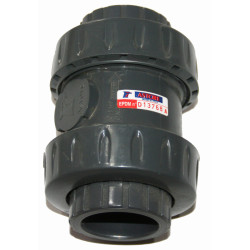
→ See the full Non-return valves range
Electrics and winter

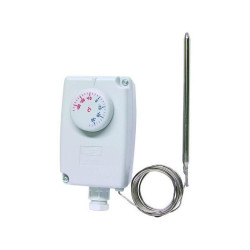
→ See the full Pool pumps range
Baskets, lids and seals depend on your pump model: see our pre-filter baskets and pump lids ranges, or send us a photo of the rating plate.
Frequently asked questions
Why is my pool pump noisy?
A gravel-like noise often comes from cavitation: suction is insufficient (blocked basket, pipe too small or too long). Vibration is more likely due to a badly mounted pump. A motor that hums without starting may have a faulty capacitor.
Why does my pump lose its prime?
Most often because of an air leak on the suction side (dry or badly seated lid seal, loose fitting) or a missing or faulty non-return valve.
Can a pool pump run dry?
No. The pump housing must be filled with water before start-up, otherwise the mechanical seal and impeller will be damaged.
How do I choose a replacement pump?
Note down the rating plate details of the old pump (flow rate, power, voltage, connection diameters) and check that your filter can handle that flow rate. Send us a photo of the plate if in doubt.
What should I do with the pump in winter?
If the filtration is shut down, drain the pump (plugs open) and keep it frost-free. If it keeps running, a frost protection thermostat can start it when the temperature drops.
How do I look after the lid seal?
Clean it every time you open the lid and lightly lubricate it with a suitable silicone grease. A dry or misshapen seal causes air leaks and loss of prime.